
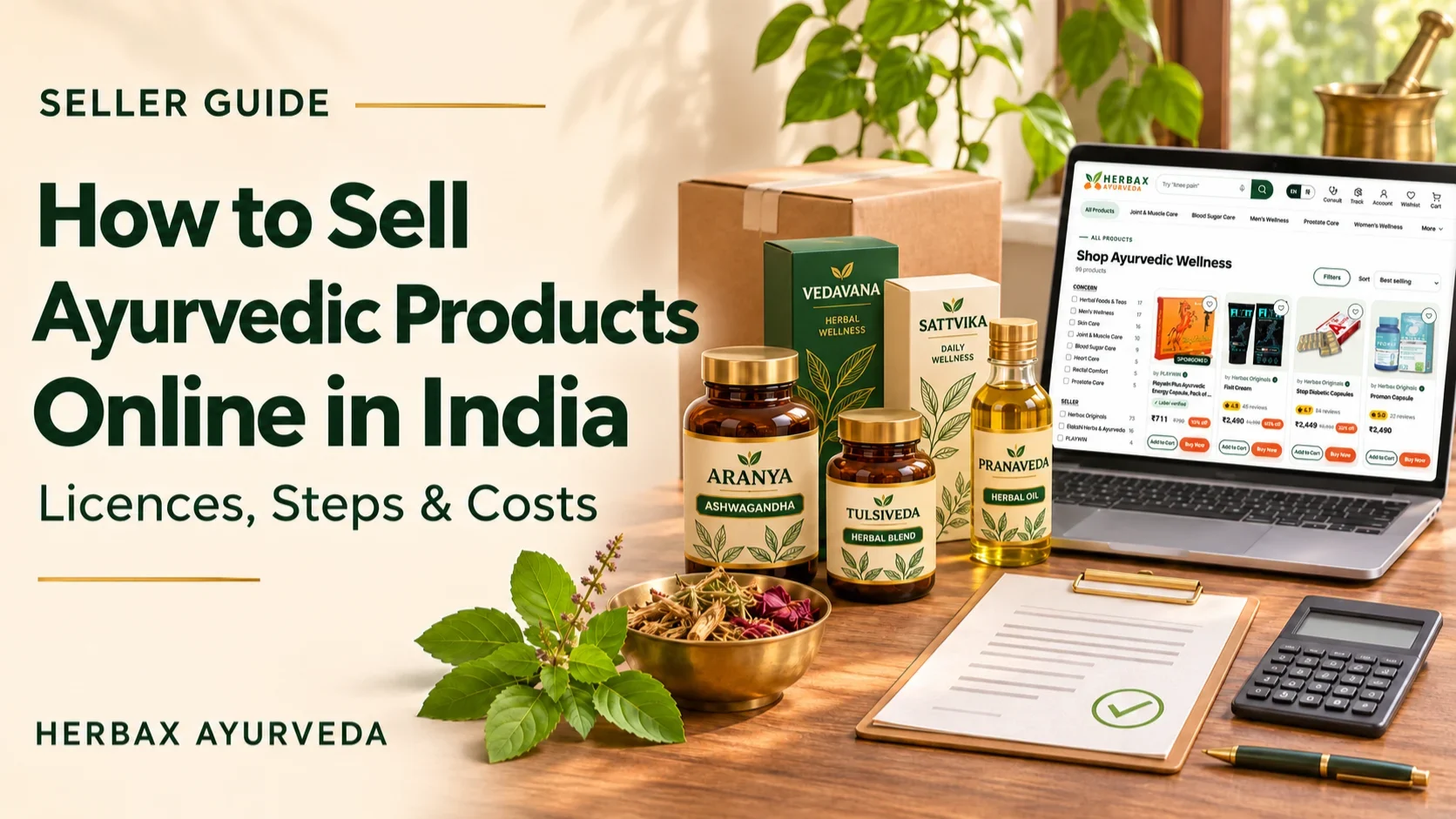
Ayurvedic products sell well online in India, but they are regulated products. Before the first order, a brand needs the right licence for each product, a tax registration, a label that follows the rules and a place to take orders. This guide walks through the steps in the order most brands follow them.
Step 1: Know what your product is in law
The licence follows the product, not the seller. The same herb can be sold as three different kinds of product:
- Ayurvedic medicine. Classical formulations from the recognised texts, and patent or proprietary medicines made from ingredients listed in those texts. These come under the Drugs and Cosmetics Act, 1940.
- Food or health supplement. Herbal teas, juices, powders and supplements sold as food come under the Food Safety and Standards Act, 2006 (FSSAI).
- Cosmetic. Creams, oils, shampoos and soaps sold for care and appearance come under the Cosmetics Rules, 2020.
Settle this first, because it decides which licence you need, what the label must say and what you may claim.
Step 2: Get the product licence
An Ayurvedic medicine must be made in a licensed unit. The licence is granted by the State licensing authority for Ayurvedic, Siddha and Unani drugs (in many States this sits with the AYUSH department or the State FDA). If you have your own factory, you apply for a manufacturing licence in Form 25-D. If you use another company's licensed factory, you can apply for a loan licence in Form 25-E, or sell the product as its marketer with the manufacturer's licence on the label.
Food products need an FSSAI registration or licence, and cosmetics need a cosmetics manufacturing licence. Our guide to licences for selling Ayurvedic products online covers each one.
Step 3: Register for GST and open a business bank account
Marketplaces collect tax at source (TCS) against the seller's GSTIN and pay settlements into a bank account in the business name, so most online sellers need a GST registration. Very small sellers who stay inside the GST exemption can sell on some marketplaces, Herbax included, with a declaration and their PAN. Ask your accountant which route applies to you.
Step 4: Get the label right
A compliant pack shows the product name, the ingredients with their quantities, batch number, manufacturing and expiry dates, the licence number, net quantity, MRP, and the name and address of the manufacturer and the marketer, with a customer care contact. Online listings must show the same key details.
Be careful with claims. Indian law does not allow advertising a product as a cure for a list of serious diseases, and marketplaces and ad platforms reject listings that promise to cure a disease. Describe what the product is traditionally used for and what it contains.
Step 5: Prepare the listing
Keep these ready before you register anywhere:
- Clear photos of the front and back of the pack, where the label can be read
- The full ingredient list and directions for use
- Pack sizes, MRP and selling price
- HSN code and GST rate
- Weight and dimensions of the packed parcel
Step 6: Choose where to sell
You can sell from your own website, on general marketplaces, or on a marketplace built for Ayurveda. Your own website gives you full control but you must bring every visitor yourself. A marketplace brings shoppers who are already looking, and handles payments, courier booking and tax paperwork for a fee.
On Herbax, an Ayurveda-only marketplace, registration takes a few minutes with your mobile number. After verification you list your products, pack each order and hand it to the courier at pickup from your address. You can register to sell Ayurvedic products on Herbax and see every fee before you start.
What does it cost?
Costs differ by marketplace. As an example, at the time of writing (November 2026) Herbax charges a commission of 5% to 15% by category on delivered orders, a 2% payment fee on online orders or a 2% collection fee on cash on delivery orders, and the actual courier charge for the parcel. GST applies on the fees. Settlements are paid every Monday. The current numbers and a calculator are on the seller fees page.
A short checklist
- Product category decided: medicine, food or cosmetic
- Licence in hand for every product
- GSTIN (or exemption declaration), PAN and business bank account
- Label checked, with no cure claims
- Pack photos and product details ready
- Marketplace or website chosen
This article is general guidance, not legal advice. Requirements differ by product and State and can change, so confirm with your State licensing authority or your consultant.
Ayurvedic wellness products support a healthy routine. They are not intended to diagnose, treat, cure or prevent any disease. If you have a medical condition, are pregnant or nursing, or take medicines, speak to a qualified practitioner first.
Related articles
Licences Needed to Sell Ayurvedic Products Online in India
Which licence applies to which product: Ayurvedic manufacturing licence, FSSAI, cosmetics licence, GST and label declarations, explained for online sellers.
How to Sell Ayurvedic Products Under Your Own Brand with a Third-Party Manufacturer
How third-party manufacturing and loan licences work for Ayurvedic brands, what to check with the manufacturer, and what you need to list online.

Gokshura (Tribulus terrestris): Uses in Ayurveda, Qualities and Forms
Gokshura, or puncture vine, is a cooling, rejuvenating Ayurvedic herb traditionally valued for urinary comfort and the strength of the reproductive system.